

ReGAIN research project
Subprojects
Our research project: diverse subprojects working together for innovation and progress
The ReGAIN consortium brings together foundries, machinery and plant manufacturers, software and systems developers, research institutions and industry associations. Organised into process and thematic clusters, the projects jointly develop software, hardware and AI assistance systems to be deployed as technology demonstrators in participating foundries.
Subprojects at a glance
19 subprojectsOpen a subproject to read its description, approach and contact details.

Subproject
Kempten University of Applied Sciences – IPI & 3Dvisionlab
Component traceability in casting and AI for quality and sustainability objectives
View details
Subproject
Kempten University of Applied Sciences – IPI & 3Dvisionlab
Component traceability in casting and AI for quality and sustainability objectives
View detailsData-driven assistance systems for mould and core production in sand casting foundries
Subproject: “Component traceability in casting and AI for quality and sustainability objectives”
Motivation:
Sand casting is important for large aluminium components, complex shapes and internal structures requiring sand cores. Most foundries in this segment are small or medium-sized enterprises. Their innovation relies on machinery developments and, to a large extent, their own experience and expertise. As important transport-sector suppliers, they must respond to industrial trends, innovation, legislation and global economic and political developments.
Alongside recent economic and political challenges, the energy transition, supply-chain carbon footprints and AI in production will strongly influence business success. For medium-sized foundries, underdeveloped and often externally managed IT infrastructure is a major barrier. Resources and expertise for digital transformation, comprehensive data systems and AI-based process and quality optimisation are often limited.
Approach:
Kempten's subproject belongs to the sand casting cluster and develops AI and machine learning models, in-process traceability and optical quality inspection systems. Model-based decision support and AI methods improve efficiency, flexibility, resilience and quality control, contributing to the wider transformation of automotive foundries.
Cross-process and, in some cases, cross-sector machine learning services support data-driven optimisation. Integration into BREOS CORE enables shared production and quality documentation and practical use of the technologies. Industrial partners and BDG support transfer through guidelines, standards and innovative training concepts for different user groups.
Results:
The cluster develops technologies for complete traceability through marking and tracking components, moulds and cores. For clay-bonded sand moulds, it considers sand properties, machine moulding, external influences and timing. Generic methods store, manage and analyse hybrid datasets, linking components to production parameters.
Surface fingerprints provide unique core identification. Integrating traceability into quality management links process and quality data for optimisation and visualisation. Data from existing equipment and mobile measuring stations supports predictive models of core and mould quality. Assistance systems derive and clearly present preventive recommendations for machine operators.
Quality data, including X-ray images and surface scans, supports AI and machine learning models for digital visual inspection of castings. Data is collected, linked and evaluated across work packages. Collaboration within the sand casting cluster develops practical digital solutions to improve production efficiency and quality.
- Subproject lead:
- Institute for Production and Informatics, Kempten University of Applied Sciences
- Cooperation partners:
- PINTER GUSS GmbH
- CMO-SYS GmbH
- MAGMA Gießereitechnologie GmbH
- BREOS GmbH
- 3Dvisionlab – Optical 3D Metrology and Computer Vision Laboratory, Kempten University of Applied Sciences
- IPI contact:
- Prof. Dr. Frieder Heieck
- Email:
- frieder.heieck@hs-kempten.de
- 3Dvisionlab contact:
- Prof. Dr. Michael Layh
- Email:
- michael.layh@hs-kempten.de

Subproject
BDG – German Foundry Association
Technology transfer and training
View details
Subproject
BDG – German Foundry Association
Technology transfer and training
View detailsIdentifying digitalisation skills needs in the foundry industry to develop tailored learning concepts
Subproject: Technology transfer and training
Motivation:
ReGAIN digitally connects foundry production systems using Catena-X. Identifying training needs and developing continuing education concepts ensures employees can use new technologies and processes effectively. BDG aims to share the results within the consortium and beyond the sector through communication and the involvement of additional foundries and users.
Approach:
The project first assesses specific training needs in participating foundries. Tailored programmes combine theory and practical training, supported by digital learning formats for different audiences. An advisory committee gathers feedback from additional foundries and users in other sectors. Talks, publications, workshops and conferences promote transfer, while digital guidelines and a learning platform make technologies and concepts accessible across the industry.
Objective:
BDG aims to secure competitiveness and support sustainable development through targeted training and effective technology transfer. Tailored education expands employees' skills, while guidelines, standards and communication activities promote adoption of innovative technologies and processes within and beyond the foundry sector.
- Subproject lead:
- BDG – German Foundry Association
- Cooperation partners:
- TU Braunschweig – IWF
- TU Braunschweig – ifs
- Kempten University of Applied Sciences – IPI
- Kempten University of Applied Sciences – 3Dvisionlab
- bridgefield GmbH
- Oskar Frech GmbH + Co. KG
- Fraunhofer IFF
- University of Kassel – GTK
- VDMA e.V.
- G. A. Röders GmbH & Co. KG
- BDG – German Foundry Association
- MAGMA Gießereitechnologie GmbH
- Contact:
- Dr. Sebastian Tewes
- Email:
- sebastian.tewes@bdguss.de

Subproject
BREOS GmbH
Extending CORE and developing demonstrator apps for AI in foundries
View details
Subproject
BREOS GmbH
Extending CORE and developing demonstrator apps for AI in foundries
View detailsExtending CORE and developing demonstrator apps for AI in foundries
Subproject: “Extending CORE and developing demonstrator apps for AI in foundries”
Motivation:
The pandemic and war in Ukraine have intensified major challenges, while the lasting effects of climate change demand timely action. Available technologies must be used to develop sustainable, efficient solutions.
German foundries face particular demands. Their ability to produce complex, lightweight, technically sophisticated castings places substantial requirements on the entire process chain.
Digitalisation can enable demand-oriented production. AI models developed with universities offer significant potential for analysis and optimisation. However, their ongoing development and maintenance can become uncertain when researchers leave their institutions after graduating.
BREOS CORE addresses this with data analytics applications and a powerful runtime environment for AI models and their frontends. Necessary interfaces and a scalable cloud-native service architecture provide a robust, sustainable platform.
As an operating environment for these models, CORE supports long-term use of digital and AI technologies in foundries. Its architecture and scalability help optimise manufacturing processes and prepare them for the future.
Approach:
BREOS develops a module for aggregating, preparing and archiving data between foundry source systems and CORE apps. Integrated into the platform, it provides the database model for storing and enriching data.
The platform is extended to integrate AI models into demonstrator apps, including interfaces, different data models and a generalised frontend with visualisations.
Traceability methods for components, sand moulds and cores are developed and tested. Existing data models are extended for AI applications to improve casting quality and production efficiency, including melt supply, core quality prediction and die temperature control. The models are integrated and visualised in CORE.
Partner collaboration creates synergies for comprehensive process optimisation and quality assurance in casting production.
Objective:
BREOS aims to deliver a maintainable platform suitable for production use, providing a lasting home for foundry AI algorithms. Work includes data processing and analysis, backend functions and AI data models for die casting, alongside traceability methods for sand casting components, moulds and cores.
- Subproject lead:
- BREOS GmbH
- Cooperation partners:
- TU Braunschweig – IWF
- TU Braunschweig – ifs
- Kempten University of Applied Sciences – IPI
- Kempten University of Applied Sciences – 3Dvisionlab
- bridgefield GmbH
- University of Kassel – GTK
- Fraunhofer IFF
- PINTER GUSS GmbH
- CMO-SYS GmbH
- Contact:
- Mr Breideneich
- Email:
- regain@breos.com

Subproject
bridgefield GmbH
Catena-X integration of standardised data acquisition in greenfield and brownfield environments across the value chain
View details
Subproject
bridgefield GmbH
Catena-X integration of standardised data acquisition in greenfield and brownfield environments across the value chain
View detailsNEW OPPORTUNITIES THROUGH CATENA-X DATA EXCHANGE ALONG THE VALUE CHAIN
Subproject: “Catena-X integration of standardised data acquisition in greenfield and brownfield environments across the value chain” (CatDeW)
Motivation:
Germany's automotive and supplier industries, particularly energy-intensive foundries, face pandemic-related pressures, higher energy and raw material costs linked to the war in Ukraine, and climate change. Industrial electricity prices rose by 50% compared with 2020, while European gas prices increased tenfold between October 2020 and October 2022. The sector's roughly 600 foundries and 70,000 employees need more sustainable, resource-efficient processes. Digitalising complex process chains can make production more resilient, sustainable and flexible.
A key foundation is stronger digital connectivity between foundries, suppliers and customers in greenfield and brownfield settings. Faster information supports operational improvements and problem-solving, improving economic and environmental performance. This requires technical solutions such as Catena-X and organisational methods for obtaining and routing the right data.
Approach:
After identifying required data exchange connections, ReGAIN partners receive Eclipse Dataspace Connectors (EDCs), providing gateways to Catena-X and cloud systems.
Shared data models provide a common language. Suitable Catena-X models are selected from requirements analysis, with new models developed where necessary, ensuring recipients understand the data as intended by senders.
The subproject connects foundries across company boundaries along the value chain.
Objective:
Its objective is secure, demand-oriented data exchange between foundries, suppliers and customers. The resulting Foundry Hub provides a foundation for connecting ReGAIN partners and their activities.
Particular attention is paid to AI services. Initial training and later retraining require substantial casting process datasets, with Catena-X providing the exchange infrastructure.
A consistent data model compatible with platforms such as AWS and Microsoft Azure allows aggregators, translators, backups and AI models to be integrated into the Catena-X Foundry Hub. Standard interfaces, appropriate communication, data governance and cross-sector knowledge transfer support broad participation, higher output and lower energy consumption.
- Subproject lead:
- bridgefield GmbH
- Cooperation partners:
- Oskar Frech GmbH + Co. KG
- Fraunhofer IFF
- G. A. Röders GmbH & Co. KG
- TU Braunschweig – ifs
- TU Braunschweig – IWF
- PINTER GUSS GmbH
- BREOS GmbH
- Wollin GmbH
- Contact:
- Prof. Dr. Frank Ortmeier

Subproject
CMO-SYS GmbH
Transferring AI and industrial machine vision for casting traceability and quality control into production
View details
Subproject
CMO-SYS GmbH
Transferring AI and industrial machine vision for casting traceability and quality control into production
View detailsAn innovative sand casting traceability system: individual component marking and core tracking
Subproject: “Transferring AI and industrial machine vision for casting traceability and quality control into production”
Motivation:
Process-chain traceability based on individual sand casting features, with localisation and classification of quality defects.
Approach:
Demonstrators are developed and installed in foundries, connected to relevant interfaces and controls. Cast codes on mould surfaces uniquely identify the resulting castings. Other demonstrators read these codes, create natural surface fingerprints of cores and recognise them during production, forwarding results to higher-level systems.
Objective:
The work package implements IPI and 3Dvisionlab research in production environments, enabling cross-process tracking of castings and their production components. Defect classification demonstrators identify process-related quality issues. They apply 3Dvisionlab methods to localise and classify shrinkage cavities, pores, cold shuts and other defects.
- Subproject lead:
- CMO-SYS
- Cooperation partners:
- Kempten University of Applied Sciences – IPI
- Kempten University of Applied Sciences – 3Dvisionlab
- PINTER GUSS GmbH
- BREOS GmbH
- Contact:
- Dr. Moritz Bommer
- Email:
- m.bommer@cmo-sys.com

Subproject
Fraunhofer IFF
AI product models for small and medium-sized foundries connected to a GAIA-X platform
View details
Subproject
Fraunhofer IFF
AI product models for small and medium-sized foundries connected to a GAIA-X platform
View detailsConnected AI models and inter-company communication improve foundry efficiency
Subproject: “AI product models for small and medium-sized foundries connected to a GAIA-X platform”
Motivation
Energy-intensive foundries have to manage several objectives at once: consistent product quality, cost-effective production, efficient energy use and the ability to respond to fluctuating energy prices, grid requirements and changing production conditions. ReGAIN therefore focused on digitally connecting production systems and on AI methods that enable process, quality and energy data to be used together.
The overarching objective of the subproject was to specify, develop and test AI process models for small and medium-sized foundries, with a view to connecting them to a GAIA-X- or Catena-X-oriented data infrastructure. Quality objectives were to be closely linked to energy flexibility objectives. A particular research focus was how deep reinforcement learning could help transfer models to changed processes, sensors, datasets and applications, and adapt them throughout their life cycle.
The subproject translated this vision into the development of AI-based integrated energy and quality optimisation. The quality strand of the overall project was supported in particular by Fraunhofer IIS's AI-based X-ray image analysis. The sustainability strand drew on the data and modelling foundation developed within the project to assess operational energy flexibility.
Objectives and approach
The starting point was to define an industrially relevant use case. Workshops and bilateral discussions between Fraunhofer IFF and the project partners established the requirements for data-driven services. In October 2025, a use case for permanent mould casting at PINTER GUSS was developed using a use-case canvas. Target users, system boundaries and scope, as well as the intended maturity levels of data analysis — from descriptive analysis to prescriptive decision support — were defined and translated into user stories.
Given the complexity of the entire foundry process chain, an important technical decision was to avoid pursuing a single global AI model. Instead, a modular structure of individual models for clearly defined subprocesses and tasks was proposed. This approach reduces dependence on a fully homogeneous data foundation and makes it easier to develop models incrementally, replace them or configure them for other applications.
Three main user groups were identified for the use case: production planning, responsible for casting schedules and furnace allocation; shift supervisors and operators in the melting area; and energy management, responsible for load management and potential marketing of flexibility. The resulting functions include AI-based recommendations for production operation, assessment of the energy flexibility of different casting schedule variants, and calculation of flexibility windows while respecting process constraints.
The objectives included reducing energy costs and peak loads while maintaining product quality, providing reliable energy flexibility in response to grid signals or forecast residual load, and avoiding merely shifting energy-related problems between process stages. Transparency for production planning and the shop floor was also to be improved.
Requirements engineering also systematically identified the data needed. These include casting schedules, batch weights, alloy types, target temperatures and cycle times, supplemented by energy prices, grid signals and load limits. Further requirements cover ambient conditions, downtime, maintenance, batch and process information, pouring times, and data on events, faults and interventions.
Minimum requirements were identified for subsequent transfer to other plants. These include sufficient instrumentation — at least for power consumption or temperature profiles and their assignment to batches — continuous data recording, standardised interfaces such as OPC UA or structured database exports, and comparable process steps and equipment types. A configurable AI and simulation framework, domain knowledge at the receiving plant and a willingness to adapt workflows are also required.
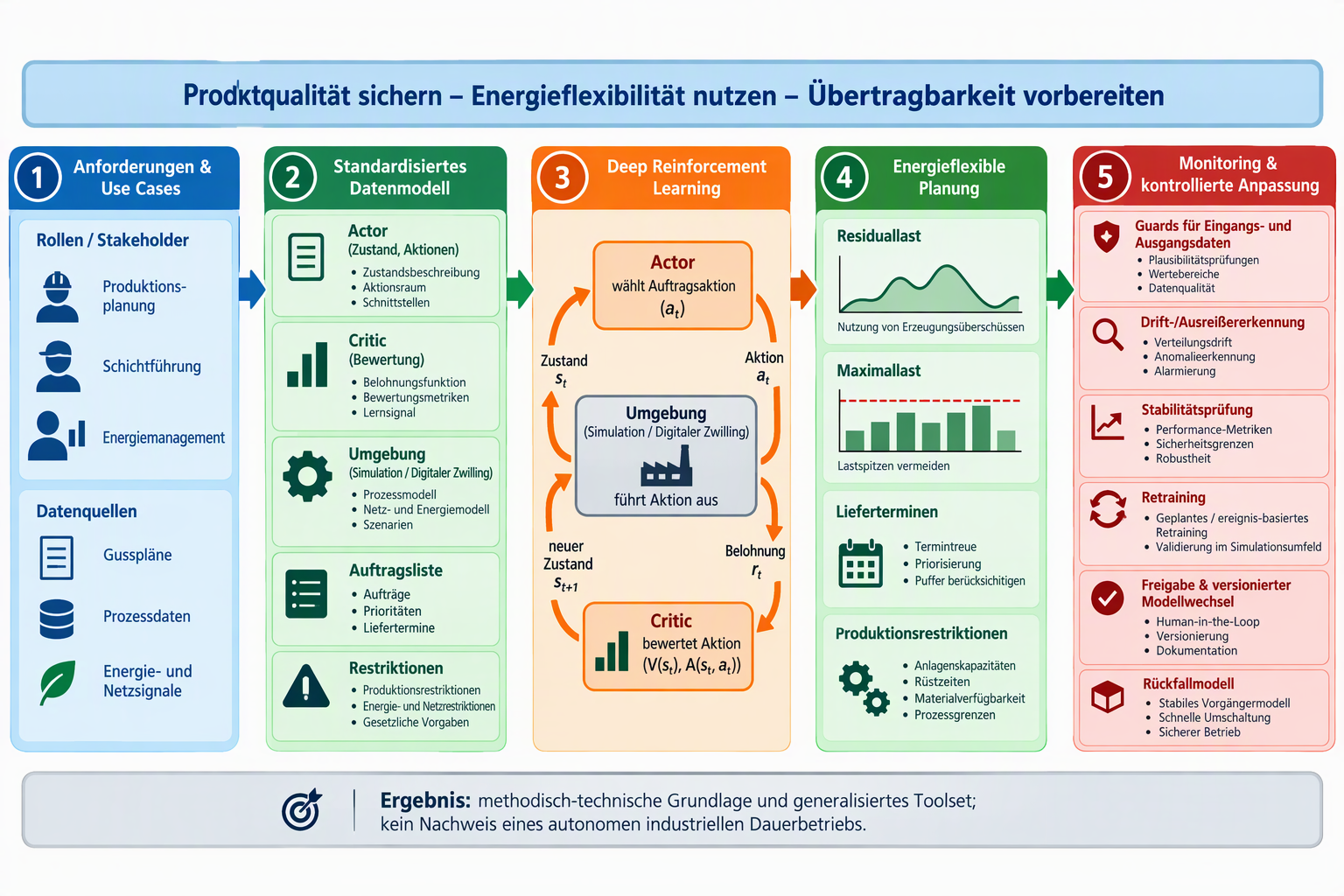
Beyond specifying requirements, IFF developed a standardised data model for key elements of deep reinforcement learning. It describes the actor and critic, the model environment, the order list and the constraints to be considered. Tools were also developed to convert data from spreadsheets, databases and live data sources into this common format. This established an essential foundation for reusable AI components without having to program every application entirely from scratch.
The following illustration shows this development chain, from industrial requirements and the actor–critic model to continuous monitoring and adaptation.
Deep reinforcement learning for energy-flexible production decisions
The task here was data-driven optimisation of energy flexibility. Different variants of deep reinforcement learning were investigated. An actor–critic model was selected as a particularly suitable approach, capable of incorporating experience from different use cases and providing a starting point for further planning tasks.
The actor selects an action step by step — in this use case, choosing an order from a list of outstanding production orders. The action is carried out in a simplified simulation environment. The critic then evaluates its effect. After each simulation round, the actor and critic are further trained using the newly generated data. In this way, the system learns to schedule orders within the period under consideration in an energy-efficient manner.
The inputs were order and machine lists, forecast residual load and parameters for operational constraints. The model can be further trained for a subsequent or overlapping planning period. The combination of a standardised data model and continuous learning provides the methodological basis for transferring existing model knowledge to other plants or use cases.
The data foundation came from the work on dynamic energy simulation and comprised PINTER GUSS order, production and energy consumption data from 2025. Time-dependent data and residual load values were processed in 15-minute intervals. Within these intervals, suitable approximations represented start and end times and energy consumption.
The optimisation objective was to align energy consumption more closely with residual load while respecting maximum loads, delivery deadlines and other process constraints. Where possible, consumption was to be shifted from periods of high residual load to more favourable time windows. Violations of defined constraints were accounted for through penalties in the simplified simulation.
This produced a technically tested approach to sequencing and start-time decisions. The result is a robust methodological and prototype foundation for learning-based, energy-flexible production planning.
Quality orientation
The work package's vision went beyond energy optimisation alone. Quality and energy flexibility were ultimately to be considered together so that energy-efficient production decisions would not compromise process stability or casting quality. Requirements engineering therefore began to link energy flexibility analysis results with casting schedules and to assess energy-related measures in terms of their possible effects on quality.
Within the overall project, the quality strand was developed in particular through Fraunhofer IIS's AI-based X-ray analysis. A defect segmentation model was trained on simulated and real industrial X-ray images, made usable for different image sizes through a tile-based workflow, and integrated into the ISAR software. Evaluation used real X-ray images and included quantitative segmentation metrics as well as a qualitative assessment through a web application.
This work is an important quality component of ReGAIN's overall approach and demonstrates the methodological integration of complementary components.
Monitoring, adaptability and controlled model switching
The concept developed in the subproject for monitoring and adapting AI models during operation was implemented as an example in a generalised toolset. Monitoring acts at three points in the AI processing pipeline: the input data, the model outputs and the behaviour of the AI model itself.
Configurable monitoring models, known as guards, can be enabled and parameterised for the input data. They compare current sensor, setting and product data with the statistics of the training data. Both individual data sources and the AI model's overall operating point are monitored statically and dynamically. Configuration parameters can be derived from the statistical properties of the training data.
The guards detect, among other things, threshold violations, changes in moving averages and distributions, and an increasing number of outliers. Constant or highly fluctuating input signals may indicate sensor faults; systematic changes may indicate drift and a need to switch models. One-class classifiers also check whether the current operating point is still sufficiently covered by the original training data.
Output data are also monitored against permitted ranges to detect erroneous results and protect downstream components. Graduated responses are envisaged: notifications for operators or modelling personnel, critical error messages with recommended actions, or fallback to a simpler, more robust AI or physical model.
AI model stability is checked by deliberately varying current input data in a model running in parallel. If a small input change causes an unexpectedly large change in the result, this may indicate an unstable operating point. In such a case, a warning should be issued and, where available, a switch made to a more stable alternative model.
For further model development, the concept envisages parallel additional training or retraining using newly generated operational and target data. A new model is first compared with the model currently in use. Before switching, an approval process covers current operating data, unusual events, extreme conditions and potential sensor failures; manual confirmation by qualified personnel may also be provided for.
The old and new model versions can temporarily run in parallel until the stability of the new model is confirmed. Model versions and model switches are logged, making it possible to trace which results were produced by which version. Retraining is envisaged particularly when sensors change or are recalibrated, new products are introduced or operating conditions change.
Results
The subproject established key foundations for transferable AI services that can be managed over the long term. These include structured requirements and role descriptions, defined data needs, a standardised data model, data conversion tools, an actor–critic-based DRL approach and a generalised monitoring and adaptation toolset.
ReGAIN thus provides a transparent architecture and tested methodological components rather than a supposedly universal AI system. These enable foundries to progress step by step from data provision and energy-flexible production decisions to monitored, adaptable AI models. For small and medium-sized companies, this creates a sound foundation for introducing AI services in a controlled manner, transferring them to further processes and developing them sustainably under changing operating conditions.
- Subproject lead:
- Fraunhofer IFF
- Cooperation partners:
- Fraunhofer IIS
- Contact:
- Aliena Oelke

Subproject
Fraunhofer IIS
AI-based X-ray analysis for casting quality assessment
View details
Subproject
Fraunhofer IIS
AI-based X-ray analysis for casting quality assessment
View detailsAI-based X-ray analysis for casting quality assessment
Subproject: “Autonomous quality characterisation of castings using radiography and AI-based image analysis”
Motivation:
Quality assurance is essential throughout casting production. Reliable defect detection and evaluation are particularly important for safety-critical parts, ensuring safe use while minimising scrap and reducing the CO2 footprint. High-throughput production often makes complete manual inspection impractical. Automated X-ray analysis detects internal defects and classifies parts against quality specifications. Detailed defect classification also supports root-cause analysis and early corrective action. Conventional systems require extensive expert configuration for every component and view, often making them uneconomic for diverse products and smaller batches. AI aims to remove this manual parameterisation so even untrained staff can set up inspection with minimal effort.Approach:
A diverse image pool supports an AI model for reliable detection and classification. Training uses historical images, data supplied by PINTER GUSS and synthetic radiographs generated from CAD models, X-ray simulations and realistic defects. Experienced X-ray specialists label real images. A web toolchain supports labelling, automated analysis, visualisation and export. First, the model detects defects and creates masks from which area and shape factors can be calculated. Second, geometric features classify defect types such as pores, shrinkage cavities and porosity, supporting root-cause analysis and assessments such as ASTM E2422. Fraunhofer EZRT extends its established ISAR inspection system with this AI option. Representative scenarios use statistically significant sample sizes, expert manual assessment, conventional ISAR and the new AI method to compare reliability and false indications.Objective:
The primary objective is reliable AI-based detection and classification of casting defects. A web tool enables analysis and model retraining. A prototype ISAR version with optional AI analysis supports industrial evaluation after the project.- Subproject lead:
Fraunhofer Institute for Integrated Circuits IIS,
Development Center X-ray Technology EZRT
- Cooperation partners:
- PINTER GUSS GmbH
- Contact:
- Dr. Frank Sukowski
Subproject
University of Kassel – GTK
Optimising die casting through AI-assisted impeller melt treatment and demand-oriented release-agent application
View details
Subproject
University of Kassel – GTK
Optimising die casting through AI-assisted impeller melt treatment and demand-oriented release-agent application
View detailsAI integration for improved melt treatment and precise release-agent application in die casting
Subproject: “Optimising die casting through AI-assisted impeller melt treatment and demand-oriented release-agent application”
Motivation:
The University of Kassel's GTK subproject uses AI to improve aluminium die casting efficiency and quality. Sensor-based digitalisation of melt cleaning and release-agent application enables optimisation that reduces energy and resource use. Continuous in-situ quality monitoring and a user-friendly visualisation interface support precise automated impeller control. Infrared thermography measures die surface temperatures to improve casting quality and support the industry's sustainable transformation.
Approach:
GTK's research is organised into the following areas.
I. Optimising die casting through AI-assisted impeller melt treatment
Casting trials and FLOW-3D simulations generate and analyse process data. Sensors capture impeller operation, while a simulation model assesses how process parameters and rotor geometry affect treatment time. AI is trained to recognise relationships. An EMC HYCAL hydrogen analyser continuously measures melt hydrogen content as the target variable. Real-time interfaces supply process data to the AI for automatic, operator-independent selection of impeller parameters and precise hydrogen control.
II. Optimising die casting through AI-assisted, demand-oriented release-agent application
Die surface temperature strongly affects casting quality. Foundries often use spraying to regulate it, but experience-based programming is not always optimal. Non-uniform temperatures are usually measured only locally and intermittently using ReGAIN – Subproject thermocouples. This subproject uses infrared cameras to capture both die halves before and after spraying. In-situ emissivity map corrections improve temperature data for the AI, which determines where and for how long release agent should be applied..
Objective:
GTK integrates AI into casting and melting. Sensor- and AI-assisted melt preparation aims to reach a defined hydrogen content in the shortest feasible treatment time, improving energy use, resource efficiency and quality. Demand-oriented spraying targets the full die surface temperature distribution to reduce porosity, shrinkage and incomplete filling. Because process conditions make reliable full-field cavity temperature measurement difficult, the project develops improved infrared measurement strategies, including in-situ emissivity correction.
Results:
The models are designed for manufacturer-independent use. Continuous melt quality monitoring, AI evaluation and automated impeller settings aim to improve quality and consistency while reducing costs. Universal integration into existing impeller processes is a priority. Demand-oriented spraying regulates die temperatures more precisely and may reduce release-agent consumption. This can improve component quality and extend tool life across aluminium die casting applications.
- Subproject lead:
- University of Kassel – Foundry Technology (GTK)
- Cooperation partners:
- IDECO GmbH
- TU Braunschweig – IWF
- BREOS GmbH
- MAGMA Gießereitechnologie GmbH
- bridgefield GmbH
- ae group ag
- Contact:
- Prof. Dr.-Ing. Martin Fehlbier

Subproject
HEITEC PTS GmbH
Inline process optimisation combining optical surface inspection and X-ray inspection
View details
Subproject
HEITEC PTS GmbH
Inline process optimisation combining optical surface inspection and X-ray inspection
View detailsAI-based surface inspection complements conventional X-ray testing
Subproject: “Inline process optimisation combining optical surface inspection and X-ray inspection”
Motivation:
HEITEC PTS experimentally extends its X-ray systems with optical surface inspection. AI examines correlations between surface and radiographic data. The aim is to identify some defective parts using lower-energy optical inspection before X-ray testing, increasing throughput or reducing the number of X-ray examinations and lowering overall energy use.
As an inspection equipment manufacturer, HEITEC PTS also contributes to data exchange standards from a user's perspective. X-ray data is more complex and voluminous than ordinary sensor data, often reaching 1–10 GB per minute.
Approach:
Project activities:
Suitable optical sensors are selected and tested, then evaluated in a laboratory setup designed for smooth integration into a production inspection system. The setup establishes the technology's capabilities and limitations.
Following feasibility testing and integration design, a sensor is installed in a customer's operating inspection system to generate real data. Digital commissioning using twins of all components identifies compatibility issues in advance and minimises production disruption.
AI methods evaluate surface quality and investigate whether surface measurements reveal defects also detected by X-ray inspection.
HEITEC PTS develops a model for efficient handling of inspection data and adds a database module to its equipment software for storing results. The module is extended to provide Catena-X-compliant export.
Objective:
Customer demonstrators gather richer component datasets without modifying the production line. AI investigates relationships between surface and X-ray results. If optical data can reliably identify defective parts, their energy-intensive X-ray inspection can be avoided, saving energy and potentially increasing inline inspection throughput.
A further objective is to make Catena-X exchange mechanisms suitable for X-ray inspection data. This is challenging because 3D inspection can generate 1–10 GB every minute, far more than typical process sensors.
- Subproject lead:
- HEITEC PTS GmbH
- Contact:
- Christoph Mühleiß

Subproject
IDECO GmbH
AI assistance systems for sustainable casting process optimisation
View details
Subproject
IDECO GmbH
AI assistance systems for sustainable casting process optimisation
View detailsMelt treatment using AI-based Melt Clean and quality analytics
Subproject: “AI assistance systems for sustainable casting process optimisation”
Motivation:
ReGAIN uses Catena-X to connect foundry systems and improve efficiency, flexibility, resilience and sustainability. Digital transparency enables new manufacturing concepts and unlocks energy and resource savings in line with the European Green Deal. The project lays the foundations for consistently defined digital product passports. IDECO and its partners develop standardised conceptual and logical melt data models and combine them with AI and simulation for multi-objective optimisation.Approach:
With GTK, IDECO develops a measurement system that proactively responds to changing casting conditions, enabling reproducible aluminium melt treatment. Better melt quality, less scrap and shorter process times produce robust, competitive manufacturing. A further aim is lower CO2 emissions through reduced scrap and the associated foundry CO2 emissions and resource consumption. QS Master is redeveloped as an AI-based proactive analysis tool that automatically presents new insights to employees. Sensors and AI apps capture the knowledge of experienced staff approaching retirement and guide melt preparation towards target conditions. Raw materials, work plans, local conditions and tool condition are incorporated into recommendations. The system relates rotor treatment, thermal analysis, hydrogen measurements and environmental data to derive and visualise actions. Continuous analysis helps managers identify gradual process drift and supports new transport and energy-sector products. Technologies must remain manageable for small foundries as well as OEMs; retrofit options reduce investment and resource use.Objective:
IDECO already supplies impeller treatment, density index, thermal analysis and hydrogen measurement systems, with connected documentation tailored to each foundry. Some larger installations include batch-release controls. ReGAIN adds AI to generate knowledge and automatically report it to designated users. Two demonstrators are developed: a sensor-equipped Melt Clean system that uses an AI database to recommend treatment parameters for current conditions, and a standalone AI Master product providing melt quality analytics.- Subproject lead:
- IDECO GmbH
- Cooperation partners:
- PINTER GUSS GmbH
- University of Kassel – GTK
- TU Braunschweig – ifs
- TU Braunschweig – IWF
- Contact:
- Olivier Dünkelmann
- Email:
- O.Duenkelmann@ideco-gmbh.de

Subproject
insightfabrix solutions
AI-based predictive quality and predictive maintenance assistance for die casting
View details
Subproject
insightfabrix solutions
AI-based predictive quality and predictive maintenance assistance for die casting
View detailsDeveloping intuitive AI assistants for die casting
Subproject: “AI-based predictive quality and predictive maintenance assistance for die casting”
Motivation:
More than 80% of die casting companies are medium-sized businesses, often relying on equipment and system suppliers for innovation. As important automotive suppliers, they face changing technologies, legislation and global economic and political conditions. Alongside recent challenges, the energy transition, the supply-chain CO2 footprint and AI will increasingly influence business success. Limited, often externally managed IT infrastructure and insufficient expertise or resources impede digital transformation. Through smartfoundry.solutions, insightfabrix offers hardware, software and services as “Solutions as a Service”. The subproject develops prototype predictive quality and predictive maintenance assistants for die casting processes and production cells.Approach:
With G. A. Röders, ae group and Julius Schüle, one production cell at each foundry is extensively digitalised and equipped for data acquisition and visualisation. Additional sensors capture machine and process information, while quality data and expert input create training datasets for predictive quality and maintenance. The smartfoundry.solutions backend is extended accordingly. Suitable semantics and ontologies capture human experience and preferred solutions. Prototype applications let experts visualise, edit and tag data. AI and machine learning models are selected, trained on the resulting datasets and validated during production for prediction accuracy and usability. They aim to reveal relationships between processes, equipment, quality and energy use. The subproject also contributes to OPC UA standardisation and Catena-X foundry use cases, simplifying equipment data collection and integration into digital supply chains.Results:
Two prototype applications test the selected models for predictive quality and predictive maintenance. Industrialising the software supports rapid adoption by medium-sized die casting foundries, improving flexibility, efficiency and resilience. OPC UA simplifies acquisition and automation, while foundry-specific Catena-X integration reduces implementation effort.- Subproject lead:
- insightfabrix solutions GmbH
- Cooperation partners:
- Julius Schüle Druckguss GmbH
- ae group ag
- G. A. Röders GmbH & Co. KG
- Contact:
- Dr.-Ing. Kai Kerber
- Email:
- kai.kerber@insightfabrix.com
Subproject
LGL GmbH
Testing energy-flexible processes and operating strategies through integrated simulation and AI models
View details
Subproject
LGL GmbH
Testing energy-flexible processes and operating strategies through integrated simulation and AI models
View detailsEnergy-efficient manufacturing through data-driven models in low-pressure casting
Subproject: “Testing energy-flexible processes and operating strategies through integrated simulation and AI models”
Motivation
The European Green Deal, disruption of energy markets by the war in Ukraine, rising prices and the transition to renewables and a circular economy create major challenges for medium-sized foundries. Complex process chains need deeper digitalisation. As a small- and medium-batch producer, LGL requires highly flexible equipment, which can incur greater energy losses than large-series production. Digital analysis targets melt quality, while dynamic energy simulation identifies improvements.
Approach:
Process, energy and quality data are digitally collected to analyse melting. Operational data collection is partly digitalised and melt quality is integrated into a shared database. A measurement concept extends existing energy metering. Anonymised data supports partner development of ReGAIN services for melt quality (IDECO, GTK Kassel, TU Braunschweig), production optimisation and dynamic energy simulation (TU Braunschweig, Fraunhofer IFF). LGL analyses energy and material flows, defines measuring points and records material inputs. Demonstrator analysis and assistance systems are tested and validated, including energy-optimised scheduling.
Objective:
The subproject demonstrates improvements through assistance systems, focusing on energy-flexible operations and melt quality. Simulation and AI support energy-optimised manufacturing, while specific recommendations help skilled operators select better process parameters.
- Subproject lead:
- Leichtmetallgießerei Bad Langensalza GmbH
- Cooperation partners:
- Fraunhofer IFF
- TU Braunschweig – ifs
- TU Braunschweig – IWF
- BREOS GmbH
- University of Kassel – GTK
- IDECO GmbH
- Contact:
- Hagen Stein
Subproject
MAGMA Gießereitechnologie GmbH
Interactive AI-based knowledge platforms for virtual shopfloor process data
View details
Subproject
MAGMA Gießereitechnologie GmbH
Interactive AI-based knowledge platforms for virtual shopfloor process data
View detailsInteractive AI-based knowledge platforms for virtual shopfloor process data
Subproject: “An interactive knowledge platform for virtual shopfloor process data combined with AI assistants”
Motivation:
The project combines real production data from multiple sources with virtual manufacturing knowledge from digital twins for near-real-time quality prediction and process control. Data transfer, sensors, analytics, AI and digital twin integration are central. A major focus is visualising this knowledge at the die casting machine, making complex relationships between settings, machine characteristics, measurements and component quality intuitive. Close industrial and research collaboration supports practical implementation.
The subproject develops technologies that advance digitalisation and Industry 4.0 in German foundries. Predicting virtual component quality within a production cycle through direct links between die casting machines and simulation models represents a new capability for the sector.
Collaboration across disciplines and industrial partners supports transfer to other processes, including core production in work packages 2.x and 3.4.x. Practical solutions are made available to science and industry.
Approach:
Work starts with automated exchange of real process data through a defined interface such as OPC UA. An app makes simulation knowledge available at the workplace. A workflow then links measured production data with simulated statistical quality data to predict quality at the machine and give early recommendations. Finally, AI and machine learning models from real production are applied to simulation data to create virtual assistants.
Objective:
The objective is to integrate and visualise simulation and digital twin knowledge in die casting, permanent mould casting and core production. AI and machine learning analyse expert knowledge embedded in model setup, definition and results. Assistants use real production data to predict quality within the manufacturing cycle and provide recommendations to operators.
- Subproject lead:
- MAGMA Gießereitechnologie GmbH
- Cooperation partners:
- Oskar Frech GmbH + Co. KG
- G. A. Röders GmbH & Co. KG
- University of Kassel – GTK
- TU Braunschweig – ifs
- Contact:
- Dr.-Ing. Marcus Schopen
- Email:
- m.schopen@magmasoft.de
- Contact:
- Dr.-Ing. Horst Bramann
- Email:
- h.bramann@magmasoft.de
Subproject
PINTER GUSS GmbH
Connected process and production data acquisition in brownfield foundries and AI assistance in manufacturing
View details
Subproject
PINTER GUSS GmbH
Connected process and production data acquisition in brownfield foundries and AI assistance in manufacturing
View detailsCreating digital product passports for the data-driven foundry of the future
Subproject: “Connected process and production data acquisition in brownfield foundries and AI assistance in manufacturing”
Motivation:
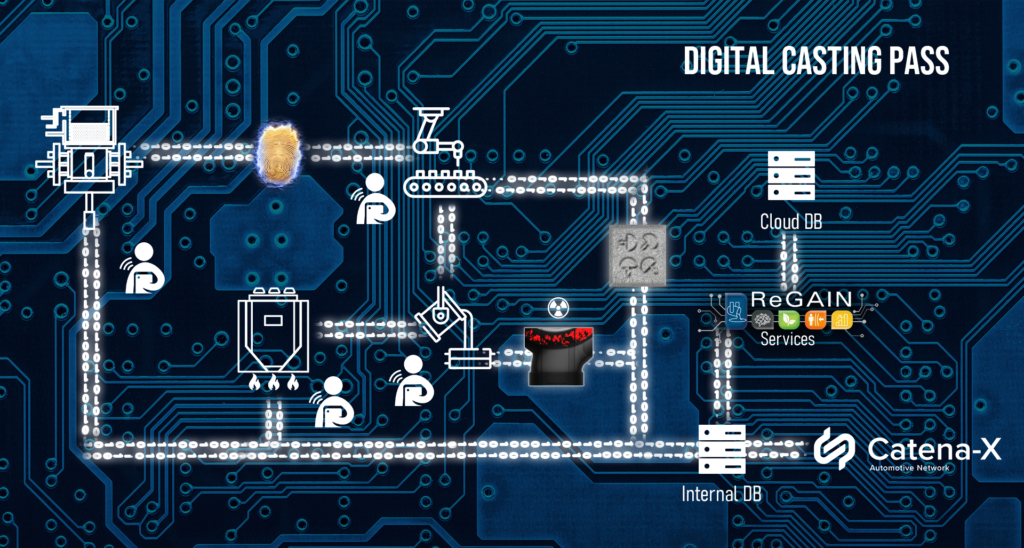
The Green Deal, disrupted energy markets, higher prices and circular-economy requirements demand efficient casting production. PINTER GUSS produces hundreds of different components in small and medium batches, requiring substantial flexibility. With its partners, it develops a fully connected process chain, extending established operating and production data collection to complex process data. Linking these data to each component creates a digital product passport and connects process parameters to quality. Statistics, AI and machine learning help explain complex interactions. The subproject demonstrates comprehensive digitalisation in an established medium-sized foundry.
Approach:
A digital product passport requires traceability throughout the process chain. Kempten University, 3Dvisionlab and CMO-SYS develop technologies for tracking castings and sand cores. Demonstrators are integrated into production and support further data collection.
Detailed process analysis requires digital acquisition of machine, process, sensor and quality data . These extend existing production data systems and are supplied to partners in anonymised form. Casting defects must be quantified and classified to relate process data to quality. 3Dvisionlab and CMO-SYS develop automatic optical surface inspection; PINTER also supports Fraunhofer IIS's X-ray work. ReGAIN services address melt quality, production and energy optimisation, and core and mould production. Demonstrators are tested and validated. The product passport also provides a basis for future carbon footprint calculation and a high-quality circular economy.
Objective:
The subproject aims to create a digital product passport that supports analysis tools and assistance systems in other subprojects. PINTER GUSS demonstrates comprehensive process-chain digitalisation in an established medium-sized foundry, aiming to reduce energy consumption and production scrap . The digital product passport also lays the foundation for future carbon footprint calculation and is an essential step towards a high-quality circular economy.
- Subproject lead:
- PINTER GUSS GmbH
- Cooperation partners:
- Kempten University of Applied Sciences – IPI
- Kempten University of Applied Sciences – 3Dvisionlab
- TU Braunschweig – ifs
- TU Braunschweig – IWF
- Fraunhofer IFF
- University of Kassel – GTK
- BREOS GmbH
- CMO-SYS GmbH
- IDECO GmbH
- University of Kassel – GTK
- Contact:
- Joshua Bissels
- Email:
- joshua.bissels@pinterguss.de
Subproject
G. A. Röders GmbH & Co. KG
Die casting process optimisation using AI-assisted methods
View details
Subproject
G. A. Röders GmbH & Co. KG
Die casting process optimisation using AI-assisted methods
View detailsDigitalising production across sites through information flows, sensors and AI to improve productivity, quality and flexibility
Subproject: Die casting process optimisation using AI-assisted methods
Motivation:
Digitalising manufacturing across sites enables earlier problem detection and improves productivity, quality and flexibility. Greater production efficiency supports the long-term viability of German manufacturing sites.
Approach:
Information flows along the manufacturing chain are modelled, measuring points identified and sensors installed. The resulting data is grouped and processed using trained AI methods to provide insights for targeted optimisation.
Objective:
The objective is a digital representation of manufacturing across sites and along the production chain. It acts as an assistance system for employee decisions and improves the design of new processes.
- Subproject lead:
- G. A. Röders GmbH & Co. KG
- Cooperation partners:
- Wollin GmbH
- TU Braunschweig – ifs
- insightfabrix solutions GmbH
- bridgefield GmbH
- BREOS GmbH
- Contact:
- Gerd Röders
- Email:
- Gerd.Roeders@regain.de
Subproject
TU Braunschweig – ifs
Process optimisation using AI-assisted methods
View details
Subproject
TU Braunschweig – ifs
Process optimisation using AI-assisted methods
View detailsImproving die casting resilience through AI assistants for release-agent application
Subproject: “Process optimisation using AI-assisted methods”
Motivation:
Many long-established foundries operate equipment of different ages with heterogeneous interfaces and data systems: a typical brownfield environment. Consistent process data collection can create significant value, especially in highly automated die casting with permanent dies. Machine learning extracts process knowledge to improve quality, predict scrap in near real time and reduce downstream costs. Models can also assess peripheral equipment and identify developing trends or failures early.
Approach:
With Wollin and AWEBA, a test setup and research die support AI development for release-agent spraying. A second model builds on spraying results and additional sensor data, such as ejector forces, to generate component-specific predictions for reliable demoulding. Numerical simulation and AI aim to reduce required machine data and create a generic model deployable after a short training period wherever the necessary data is available. Following research trials at the Soltau Light Metal Centre, the models are validated in production at G. A. Röders. Successful models are combined in a cloud system accessible through BREOS CORE.
Objective:
The resulting spraying assistant adjusts release-agent quantities by region according to die temperature distribution and thermal balance. It responds to process fluctuations and improves resilience through digital process representation. Combined with demoulding prediction, it aims to reduce scrap and improve efficiency, profitability and sustainability. Cloud integration supports access with minimal hardware dependence, while visualisation makes results easier to interpret.
- Subproject lead:
- Technische Universität Braunschweig – Institute of Joining and Welding
- Cooperation partners:
- Wollin GmbH
- G. A. Röders GmbH & Co. KG
- University of Kassel – GTK
- bridgefield GmbH
- BREOS GmbH
Associated partner:
- AWEBA Werkzeugbau GmbH
- Bühler AG
- Contact:
- Jan Nordmeier
Subproject
TU Braunschweig – IWF
Multi-criteria AI assistance systems for sustainable, energy-efficient casting
View details
Subproject
TU Braunschweig – IWF
Multi-criteria AI assistance systems for sustainable, energy-efficient casting
View detailsProcess improvement and CO2 -oriented energy flexibility in permanent mould casting using AI and simulation
Subproject: “Multi-criteria AI assistance systems for sustainable, energy-efficient casting”
Motivation:
ReGAIN connects foundry systems through Catena-X to improve efficiency, flexibility, resilience and sustainability. Digital transparency enables new manufacturing concepts and unlocks energy and resource savings in line with the European Green Deal. IWF develops multi-criteria AI approaches that optimise process quality, energy efficiency and environmental impacts. Objectives include lower resource use through virtual quality prediction, minimising the CO2 footprint through energy simulation and improving product quality. Melting is a particular focus: high-quality melts are essential to permanent mould casting, especially with increasing use of secondary alloys. Dense process data enables analysis of complex relationships and recommendations for quality and energy improvements. Models consider energy use and the associated CO2 footprint alongside process quality.Approach:
The approach follows the cyber-physical production system (CPPS) cycle shown in the figure. Its four areas—physical world, data acquisition, cyber world and decision support—define the development and implementation stages.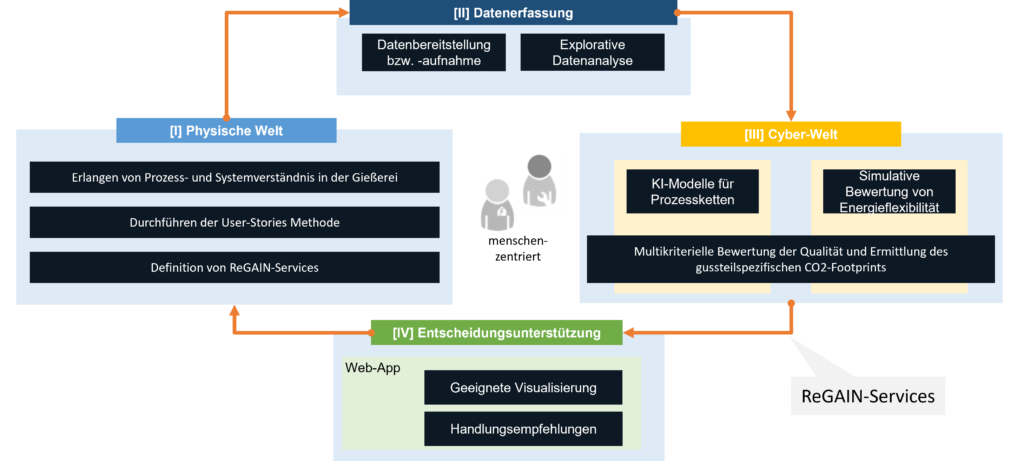
- Prediction of production stoppages
- Control of the impeller treatment process
- Prediction of casting quality
- Prediction of melt composition during alloying, modification and grain refinement.
Results:
The services provide real-time decision support and derive process and product quality features for control and optimisation. Demonstrator assistants make the models usable by stakeholders. Simulations also assess energy requirements, efficiency and environmental impacts as process conditions change, deriving recommendations for energy-flexible operation and alternative heat and electricity pathways. Combining both approaches creates a data-driven, multi-criteria service for quality- and energy-optimised planning and operation.- Subproject lead:
- TU Braunschweig – IWF
- Cooperation partners:
- PINTER GUSS GmbH
- University of Kassel – GTK
- IDECO GmbH
- HEITEC PTS GmbH
- Fraunhofer IIS
- Fraunhofer IFF
- BREOS GmbH
- bridgefield GmbH
- LGL GmbH
- Contact:
- Organisation & AI: Marija Lindner
- Contact:
- Energy and simulation: Benjamin Uhlig
- Email:
- b.uhlig@tu-braunschweig.de
Subproject
VDMA e.V.
Standardising foundry operating data
View details
Subproject
VDMA e.V.
Standardising foundry operating data
View detailsInteroperability through standardised OPC UA interfaces for foundry operating data
Subproject: “Standardising foundry operating data”
Motivation:
The energy-intensive, largely medium-sized foundry sector is vital to machinery and automotive manufacturing. Higher energy costs associated with the pandemic and war in Ukraine have created substantial challenges. The European Green Deal also targets a reduction in CO2 emissions of 50–55% by 2030 compared with 1990. Germany's steel and aluminium casting industry faces strong competitive, delivery and quality pressures. Intelligent production and digitalisation can turn data into process and quality improvements. Standardised interfaces broaden these opportunities and improve flexibility and resilience. The subproject develops OPC UA interfaces for foundry operating data and AI process chains, published as an open industry standard.Approach:
VDMA represents mechanical and plant engineering and develops open standards with the partners. The work addresses heterogeneous proprietary solutions and transferability. Standards describe foundry processes and modules while aligning with OPC UA for Machinery and High Pressure Die Casting to avoid isolated solutions. Interfaces cover permanent mould, sand, core package and die casting. First, gaps in information modelling are prioritised and models developed for key data used in work packages 1 and 2. These are then converted into OPC UA specifications, drawing on VDMA's experience from more than 40 working groups. Publication through VDMA and the OPC Foundation enables global adoption beyond the project. The umati open-source community publishes and tests implementations for consistent cross-industry use.Objectives and results:
VDMA develops an open, standardised OPC UA interface and reference implementation for foundry machinery. Vendor-independent specifications describe operating and production data. They are made freely available through VDMA and the OPC Foundation, with published and tested software implementations.- Subproject lead:
- VDMA – Mechanical Engineering Industry Association
- Contact:
- Dr.-Ing. Thomas Dasbach
- Email:
- thomas.dasbach@vdma.org
- Contact:
- Zain Aabideen
- Email:
- zain.aabideen@vdma.org
Subproject
Wollin GmbH
Optimising release-agent application in die casting using AI-assisted methods
View details
Subproject
Wollin GmbH
Optimising release-agent application in die casting using AI-assisted methods
View detailsImproving die casting resilience through AI assistants for release-agent application
Subproject: “Optimising release-agent application in die casting using AI-assisted methods”
Motivation:
Germany's predominantly medium-sized die casting industry faces higher energy costs, increasingly complex and larger automotive components, stricter quality requirements, international competition and a growing shortage of skilled workers. Substantially improved automation is needed to address these pressures.
Die casting involves many interdependent parameters, requiring new AI assistants and machine learning methods. Existing equipment often lacks suitable interfaces, data models and sufficiently detailed measurements, so these foundations must first be established.
As a release-agent application specialist, Wollin investigates how to digitalise a process that has largely operated without feedback control. The aim is to provide data for higher-level optimisation and feed model results back into production.
Approach:
With TU Braunschweig, typical spraying faults are categorised and reproduced on real spraying systems. A test rig using an AWEBA die measures their effects and automatically generates sufficiently large training datasets.
In parallel, a data model describes release-agent application across the die geometry for different spray tool configurations, motion programmes and process parameters. It initially supplies target values and later measured values to the partners.
Existing partner spraying systems are extended to implement AI optimisation results automatically.
Wollin also contributes to OPC UA standardisation of the resulting models and interfaces, making future integration into industrial equipment easier.
Objective:
The objective is to capture and digitally represent release-agent application sufficiently for AI-based control. The process is currently largely set up manually and operates without continuous feedback. Practical demonstrations with TU Braunschweig and G. A. Röders show the approach. Since spraying strongly influences scrap and component quality, this can improve profitability and resilience across die casting.
- Subproject lead:
- Wollin GmbH
- Cooperation partners:
- TU Braunschweig – ifs
- G. A. Röders GmbH & Co. KG
- Contact:
- Björn Wollin
- Email:
- bjoern.wollin@wollin.de