

ReGAIN research project
Working groups
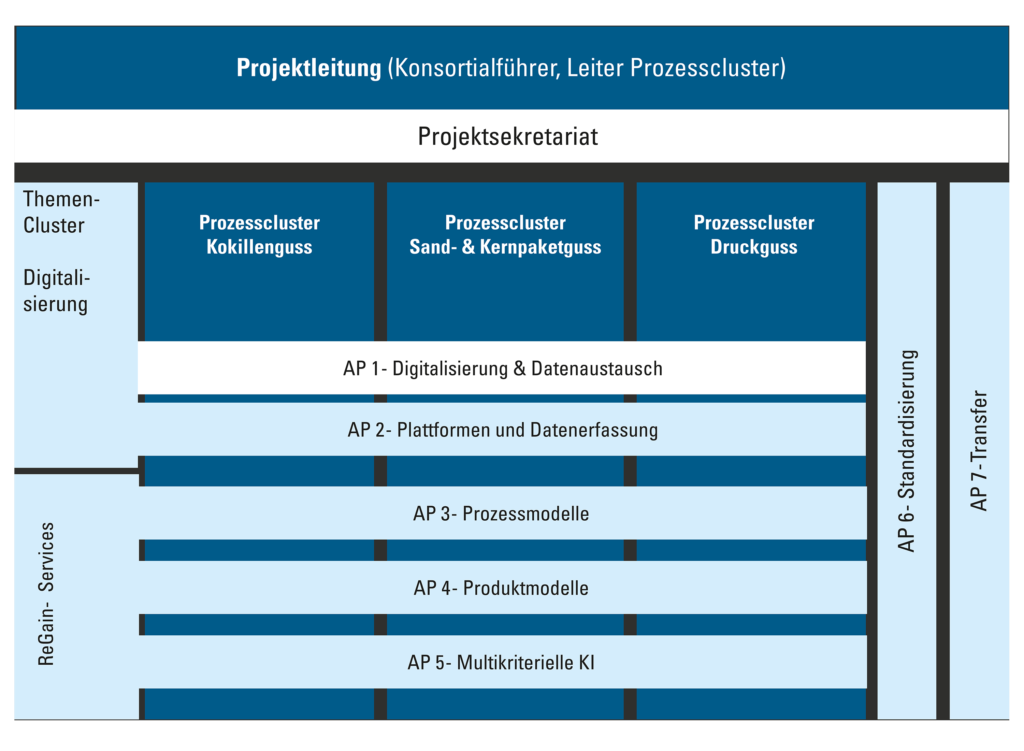
The ReGAIN team is organised into process and thematic clusters
The ReGAIN consortium brings together foundries, machinery and plant manufacturers, software and systems developers, research institutions and industry associations. Organised into process and thematic clusters, the projects jointly develop software, hardware and AI assistance systems to be deployed as technology demonstrators in participating foundries.
The process clusters combine expertise in three casting processes:
- PC 1: Sand casting
- PC 2: Permanent mould casting
- PC 3: Die casting
Two cross-cutting working groups standardise and develop interfaces within companies (OPC UA) and between companies (Catena-X).
Early identification of technology transfer and training needs, supported by a digital learning platform, accelerates practical adoption and transfer to other casting processes.
Process clusters
3 areas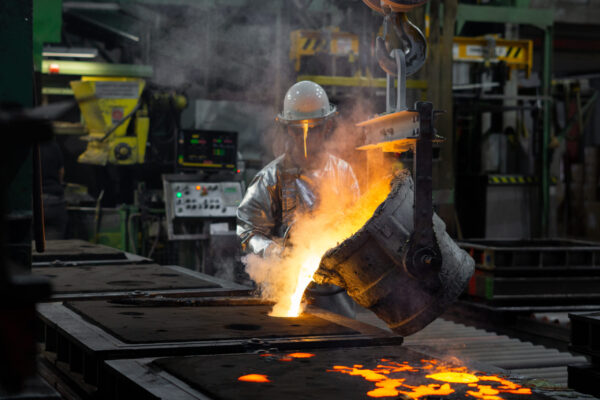
Sand casting process cluster
View details
Sand casting process cluster
View detailsDigital manufacturing in sand casting: efficiency through connected value creation
Motivation:
The cluster integrates the complex production systems of a green sand machine-moulding foundry into a connected value creation system. Digital transparency enables new manufacturing concepts and reliable links between process and quality data, which remain difficult and costly in this environment. Data-driven optimisation and visualisation make it possible to understand the multivariate relationships between individual production stages and the technical, economic and environmental performance of castings. AI and machine learning models predicting mould and core quality offer a major advance. Their predictions feed dedicated assistance systems, connecting the casting process with the people responsible for it.
Approach:
The process cluster follows these steps:
First, the partners develop a shared understanding of the system, focusing on sand preparation, moulding, pouring and core production. This provides the basis for defining ReGAIN services at different stages of the foundry process chain.
Green sand machine moulding involves many closely interconnected processes. Their combined influence on casting quality can currently be analysed only to a limited extent. Quality data cannot yet be reliably and precisely linked to individual process settings and the overall production process.
An end-to-end digital process chain requires linked systems for unambiguous traceability of cores, moulds and castings and for automated defect detection. Surface scans provide each sand core with a fingerprint linked to its production data. A specially developed robotic tool marks the sand mould so that the mark transfers to the casting. After shakeout, the mark is read and linked to all relevant process and core data. Image analysis methods also provide objective, quantitative assessment of casting surface defects.
Precise analysis requires dense data throughout the process chain. Alongside traceability and quality inspection, partners develop, verify and validate the data acquisition infrastructure. They analyse existing foundry data structures and management systems and jointly define service requirements. Processes may need additional sensors, while existing sensors are evaluated for their usefulness. Continuous data acquisition enables exploratory analysis and forms the foundation for ReGAIN services in machine moulding.
In addition to data acquisition and management, the services include prediction models using suitable machine learning methods, including neural networks and deep learning. The following AI models are developed from process data:
- Assessment of sand preparation and moulding material properties,
- Prediction of compacted mould quality,
- Prediction of core quality based on visible defects,
- Prediction of casting quality in relation to sand-related surface defects.
Complete data acquisition also requires the following models:
- Detection and classification of casting surface defects,
- Localisation and quantification of individual casting marks.
Combining these models with mathematical optimisation and domain knowledge creates practical decision-support systems. They help process engineers and operators monitor and plan production, presenting results in an intuitive and understandable way.
The overarching aim is to combine the models for multi-criteria assessment of both process quality and casting quality.
The resulting control methods are adapted to each foundry's conditions. They must ensure stable, robust processes despite measurement uncertainty, variables that cannot be measured online and relationships that cannot be precisely quantified. Three development pillars support this:
- Robust, continuous data acquisition and complete traceability for every casting,
- Self-learning subprocess systems connected through an overarching process supervisor,
- A process supervisor that combines domain knowledge and machine learning to recommend optimal settings and support operators' decisions.
Results:
The project develops (i) standardised data models and interfaces for Catena-X, (ii) AI and simulation approaches for multi-objective optimisation of foundry processes and production systems, particularly resilience and the CO2 footprint, together with an AI app ecosystem for federated machine learning and analytics, and (iii) contributions to OPC UA standardisation and technology transfer within and beyond the industry. The cluster pursues the following scientific and technical objectives:
Process-specific and cross-process AI and simulation methods optimise multiple objectives and make effective use of process data. Alongside economic and quality criteria, process design and optimisation address resource and energy efficiency, including the CO2 footprint. This supports stable, efficient process chains and flexible, resilient operation. The approaches are integrated into assistance systems and app environments for straightforward use.
The sand casting cluster addresses efficiency, quality and sustainability in casting production. Current limitations include incomplete traceability of production parameters from existing equipment and mobile measuring stations, limited data-driven optimisation and insufficient digital quality inspection. Digital solutions will link each casting to its mould, core and production parameters. Sand preparation, machine moulding, core shooting, external influences and timing are considered. Optical methods capture traceability codes and quality defects on cores and castings. Linking process and quality data supports robust production that meets future energy and resource efficiency requirements.
Work focuses on sand preparation, moulding and core production, where complex interactions affecting final casting quality remain insufficiently understood. Complete datasets enable machine learning models to predict process outcomes and casting quality features. Prediction-based optimisation combined with domain knowledge provides preventive recommendations for machine operators.
The results serve aluminium, iron and steel sand casting foundries and companies developing production and quality management systems. Methods and technologies are designed to be transferable across foundry manufacturing. Close partner collaboration ensures practical relevance, adaptability and operational usability.
Subproject lead:
Kempten University of Applied Sciences
Cooperation partners:
- PINTER GUSS GmbH
- Kempten University of Applied Sciences – IPI
- Kempten University of Applied Sciences – 3Dvisionlab
- CMO-SYS GmbH
- MAGMA Gießereitechnologie GmbH
- BREOS GmbH
Permanent mould casting process cluster
View details
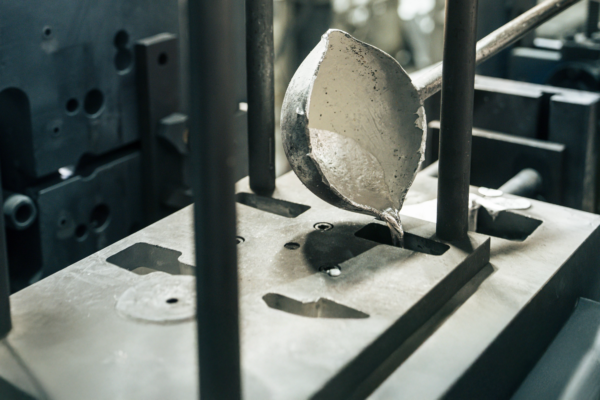
Permanent mould casting process cluster
View detailsEfficient permanent mould casting through
optimised melts and
intelligent process control
Motivation:
High-quality melts are essential to improving permanent mould castings. Increasing use of secondary alloys makes detailed knowledge of process parameters especially important. Optimised process control must improve casting quality and reduce energy use. Dense process data enables systems to analyse complex relationships and provide targeted recommendations. These consider process quality, energy consumption and the associated CO2 footprint, supporting resource-efficient, environmentally responsible production and compliance with legal requirements.
Approach:
The process cluster follows these steps:
The partners first develop a thorough system understanding through site visits to Pinter Guss and LGL. The focus is the aluminium permanent mould casting process chain, providing the basis for defining ReGAIN services at its different stages.
Precise analysis requires dense data across the process chain. The necessary acquisition infrastructure is built and tested. Partners jointly define the types, formats and sampling frequencies of process, quality and energy data needed by the services. Pinter Guss, LGL and the University of Kassel's GTK collect the data.
Exploratory analysis provides initial insights into the data, which forms the foundation for developing ReGAIN services.
AI models and simulations are then developed using machine learning, neural networks and deep learning. Planned models include:
- Prediction of production stoppages
- Control of the impeller treatment process
- Prediction of casting quality
- Prediction of melt composition during alloying, modification and grain refinement
- Analysis and optimisation of X-ray inspection
- Inline process optimisation combining optical surface inspection and X-ray inspection
Simulation methods also model energy use across processes and process chains. They support environmental assessment, particularly calculation of the CO2 footprint. The simulations assess how system configurations, such as photovoltaics and future equipment, and production scheduling based on renewable energy availability affect each casting's CO2 footprint.
Finally, ReGAIN services combine modelling with assistance systems for decision support. They help operators and other stakeholders monitor and plan production, presenting model results visually. Combining the models enables multi-criteria assessment so that process quality, energy efficiency and environmental impact can be optimised together.
Results:
The project develops (i) standardised data models and interfaces for Catena-X, (ii) AI and simulation approaches for multi-objective optimisation of foundry processes and production systems, particularly resilience and the CO2 footprint, together with an AI app ecosystem for federated machine learning and analytics, and (iii) contributions to OPC UA standardisation and technology transfer within and beyond the industry. The cluster pursues the following scientific and technical objectives:
Process-specific and cross-process AI and simulation methods optimise multiple objectives and make effective use of process data. Alongside economic and quality criteria, process design and optimisation address resource and energy efficiency, including the CO2 footprint. This supports stable, efficient process chains and flexible, resilient operation. The approaches are integrated into assistance systems and app environments for straightforward use.
The permanent mould casting cluster focuses particularly on melting. High-quality melts are critical to casting quality, especially with increasing use of secondary alloys. Detailed process data enables analysis of complex relationships and recommendations for improved quality and energy use. The models also consider the resulting CO2 footprint. The European Green Deal and initiatives to incorporate the CO2 footprint into supply-chain procurement criteria require better dynamic energy simulation at product level. Work therefore includes gathering the necessary data and refining energy management systems. These data feed simulations of process-chain energy consumption and environmental assessment, including the CO2 footprint. Combining the models supports simultaneous improvement of process quality, energy efficiency and environmental performance.
Subproject lead:
Technische Universität Braunschweig – Institute of Machine Tools and Production Technology (IWF)
Cooperation partners:
- PINTER GUSS GmbH
- University of Kassel – GTK
- IDECO GmbH
- HEITEC PTS GmbH
- Fraunhofer IFF
- Fraunhofer IIS
- BREOS GmbH
- bridgefield GmbH
- LGL GmbH
Die casting process cluster
View details
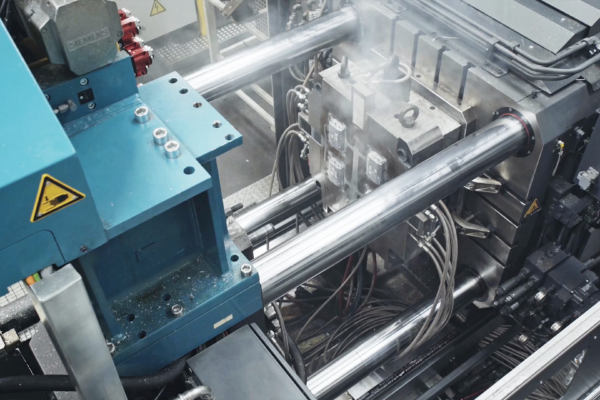
Die casting process cluster
View detailsControlled solidification for maximum
component quality in die casting
Motivation:
Solidification conditions are central to defect-free die castings. Reproducible local die temperatures must ensure component-specific directional solidification despite external influences. AI-assisted, targeted release-agent spraying after each shot regulates local surface temperatures and supports reliable demoulding. Sensors inside and outside the cavity, together with new interfaces, provide data that AI analyses alongside machine, peripheral and process data to calculate spray parameters. Benefits include minimum-quantity spraying, nozzle setup assistance and prediction of emerging quality defects or temperature drift. Broader assistance systems address predictive quality and predictive maintenance for multi-objective optimisation. Methods also capture human experience and geometric and technical relationships to train models and constrain their permitted actions.
Approach:
The die casting work has two main areas: AI-assisted process optimisation, and assistance systems for production quality and production-system performance, including condition monitoring and predictive maintenance.
With Wollin and AWEBA, a test setup and research die are developed to train a release-agent spraying model. A second model builds on spraying and additional sensor data, including ejector forces and cavity measurements, to ensure reliable demoulding. Numerical simulation combined with AI aims to reduce the machine data required and produce a generic model usable on different die casting machines after a short training period, provided the necessary data are available. Following trials at the ifs research foundry in the Soltau Light Metal Centre, the models are validated in production at G. A. Röders. Successful models are combined into a cloud system accessible through the BREOS CORE platform.
A further subproject defines visualisation and functionality requirements for production optimisation and predictive maintenance. Machine, process and quality data are gathered and preprocessed in several die casting foundries. Additional data support overall efficiency and the CO2 footprint. Information is prepared for different roles and training levels. Foundry staff and process experts review it, identify improvements and document their findings using the semantics and ontologies developed in work package 2. Their experience helps prepare and enrich training data for machine learning and AI models.
Primary data, tags and expert knowledge are combined in the developed semantics and ontologies to create training datasets. Prototype assistance systems then support employees in optimising die casting processes.
Results:
The project develops (i) standardised data models and interfaces for Catena-X, (ii) AI and simulation approaches for multi-objective optimisation of foundry processes and production systems, particularly resilience and the CO2 footprint, together with an AI app ecosystem for federated machine learning and analytics, and (iii) contributions to OPC UA standardisation and technology transfer within and beyond the industry. The cluster pursues the following scientific and technical objectives:
The cluster develops models for temperature control in conjunction with release-agent spraying, predictive quality and selected predictive maintenance applications. Partner collaboration builds a comprehensive understanding of optimisation opportunities. Integrating the models enables cross-process control, improving quality assurance and efficiency. Demonstrator apps in BREOS CORE present the results.
Model-based casting simulation also supports AI-assisted simulation and optimisation of quality and energy use. Work packages 3.5 and 4.1 jointly develop an app that prepares complex simulation results for practical use in manufacturing.
Subproject lead:
Technische Universität Braunschweig – Institute of Joining and Welding (ifs)
Cooperation partners:
- G. A. Röders GmbH & Co. KG
- insightfabrix solutions GmbH
- Wollin GmbH
- University of Kassel – GTK
- MAGMA Gießereitechnologie GmbH
- BREOS GmbH
- bridgefield GmbH
- ae group ag
- Julius Schüle Druckguss GmbH
- Bühler AG
- AWEBA Werkzeugbau GmbH
Digitalisation and interfaces
3 areas
Digitalisation thematic cluster
View details
Digitalisation thematic cluster
View detailsData-driven foundries: greater efficiency and fewer defects through digital
connectivity
Motivation:
Digitalisation makes foundries more efficient, flexible and future-ready. This cluster combines data from many sources to provide transparency across complex production processes. The consolidated data supports analysis, predictive maintenance and defect reduction. Interoperability through OPC UA and the Catena-X Eclipse Dataspace Connector is central, enabling adaptive systems that respond to changing requirements. Cloud platforms such as BREOS CORE provide the basis for processing data and using insights, supporting environmental and economic sustainability in line with the European Green Deal.Approach:
Existing standards and technologies are adapted to foundry requirements for data exchange within and between European companies. OPC UA is extended to support reliable, sector-specific communication and a connected European ecosystem. Catena-X use cases are adapted so production data can be shared along the value chain and used for process optimisation, transparency, flexibility and resilience. Cloud platforms such as BREOS CORE aggregate and analyse large datasets and support foundry-specific AI models. Combining these approaches through partner collaboration enables new digital manufacturing concepts, improves environmental sustainability and strengthens international competitiveness.Results:
The project develops (i) standardised data models and interfaces for Catena-X, (ii) AI and simulation approaches for multi-objective optimisation of foundry processes and production systems, particularly resilience and the CO2 footprint, together with an AI app ecosystem for federated machine learning and analytics, and (iii) contributions to OPC UA standardisation and technology transfer within and beyond the industry. The digitalisation cluster focuses on practical improvements across foundry production. Standardised Catena-X data models and interfaces enable consistent data exchange, supporting use cases such as real-time production monitoring and logistics optimisation. An AI app ecosystem supports federated analytics and machine learning to improve efficiency, resilience and CO2 reduction. BREOS CORE offers flexible data processing and specialised AI models, allowing companies to adapt production to changing requirements. OPC UA and Catena-X support adaptive, robust production control. Intelligent assistance systems stabilise and adjust processes in real time, improving quality and energy and resource efficiency. The cluster lays the groundwork for resilient, resource-efficient foundry production and supports the European Green Deal.Subproject lead:
BREOS GmbH
Cooperation partners:
- TU Braunschweig – ifs
- TU Braunschweig – IWF
- University of Kassel – GTK
- PINTER GUSS GmbH
- Fraunhofer IFF
- bridgefield GmbH
- HEITEC PTS GmbH
- CMO-SYS GmbH
- Kempten University of Applied Sciences – IPI
- Kempten University of Applied Sciences – 3Dvisionlab
- VDMA e.V.
- insightfabrix solutions GmbH
OPC UA interface
View details
OPC UA interface
View detailsEfficient industrial data communication: the role of OPC UA
Motivation:
Digitalisation offers substantial opportunities to use foundry data for process optimisation and quality improvement. AI can create additional value from these data. Standardised interfaces broaden applications and improve flexibility and resilience. The subproject develops OPC UA interfaces for foundry operating data as a foundation for AI-assisted process chains. They will be published as an open industry standard to support widespread adoption and rapid integration.
OPC UA (Open Platform Communications Unified Architecture) comprises specifications developed by industrial suppliers, end users and software developers. It defines both data transport mechanisms and a modelling language for formalising information models. Transport mechanisms cover client-server and server-server communication, access to real-time and historical data, alarms and events. OPC UA uses industrial protocols including TCP/IP and MQTT.
The standard provides a graphical, UML-based modelling approach for nodes and flexible information models. Sector-specific models can be standardised to create vendor-independent interfaces. These OPC UA Companion Specifications are developed by industry working groups through organisations such as VDMA and the OPC Foundation and published as publicly available specifications. References [1] and [2] provide further information.
Approach:
VDMA and the project partners develop an open OPC UA interface standard for foundries, addressing fragmented proprietary solutions and transferability. ReGAIN's Companion Specifications describe operating data for foundry processes and modules, taking account of existing standards such as OPC UA for Machinery and the modular structure of High Pressure Die Casting. This supports interoperability and avoids isolated solutions.
The project defines interoperable interfaces for different casting processes, standardising operating data for AI process-chain models. Supplier and end-user working groups first analyse and structure gaps in information modelling, then develop standardised Companion Specifications. These are published through VDMA and the OPC Foundation. The umati community [3] publishes and tests implementations to support consistent adoption across sectors.
Results:
Vendor-independent OPC UA Companion Specifications are developed for the foundry industry. Once complete, they are made freely available through the DIN publication notice as VDMA specifications and globally through the OPC Foundation. Their software implementations are also published and tested.
Subproject lead:
VDMA – Mechanical Engineering Industry Association
References:
[1] https://opcfoundation.org/developer-tools/documents
[2] https://www.vdma.org/interoperabilitaet
[3] https://umati.org/

Catena-X interface
View details
Catena-X interface
View detailsNew opportunities through Catena-X data exchange along the value chain
Motivation:
Connectivity is increasingly important in industry. Customers must coordinate orders and delivery times with suppliers; goods in transit act as virtual inventory. Poor planning and missing information can quickly lead to major losses. Environmental protection, including the CO2 footprint, also requires appropriate connectivity.
Catena-X was developed to create a shared communication basis across the automotive value chain. It is a decentralised network in which partners communicate directly. Core services broker connections and help discover data and data providers. Each partner hosts an Eclipse Dataspace Connector (EDC), which establishes secure connections and permits only authorised access to data.
These benefits make Catena-X suitable for connecting foundries with suppliers and customers.
Approach:
Catena-X implementation in ReGAIN follows these steps:
-
- Define data exchange infrastructure requirements
- Specify the Foundry Data Backbone
- Connect ReGAIN services
- Connect digital ecosystems
- Evaluate and test
In step 1, partners specify who communicates with whom, which data are exchanged and in what format. Formats determine both shared understanding and the granularity of information. For example, the CO2 footprint could be shared as a daily total or per product. The partners assess what level of detail is achievable with reasonable effort.
In step 2, implementation begins with ReGAIN's Catena-X core services. The partners check which required data, such as the CO2 footprint, already have Catena-X models. Where models are missing, existing ones are adapted or new ones defined, for example for AI training data.
Step 3 connects partners and services to Catena-X. EDCs are adapted to each partner and connected to internal systems that supply or retrieve data.
Because ReGAIN's AI services run in cloud environments such as AWS or Azure, step 4 develops an EDC that simplifies the connection between Catena-X and the cloud.
The work concludes with step 5, testing and evaluating the network. A demonstrator illustrates how the Catena-X network works in ReGAIN.Results:
The project develops (i) standardised data models and interfaces for Catena-X, (ii) AI and simulation approaches for multi-objective optimisation of foundry processes and production systems, particularly resilience and the CO2 footprint, together with an AI app ecosystem for federated machine learning and analytics, and (iii) contributions to OPC UA standardisation and technology transfer within and beyond the industry. The cluster pursues the following scientific and technical objectives:
The work package connects participating foundries with their suppliers, customers and subcontractors.
Required data should be shared securely in consistent formats, with new connections easy to establish. Models are created or adapted for optimisation and AI applications. Sharing datasets through Catena-X must be distinguished from querying services: regular transfer of large datasets along the value chain is appropriate, while individual AI service queries would involve excessive overhead. Catena-X can therefore exchange training data but is not intended for querying AI services directly.
Subproject lead:
bridgefield GmbH
Cooperation partners:
- BREOS GmbH
- insightfabrix solutions GmbH
- PINTER GUSS GmbH
- Fraunhofer IFF
- University of Kassel – GTK
- TU Braunschweig – ifs
- TU Braunschweig – IWF
- Wollin GmbH
- G. A. Röders GmbH & Co. KG
- LGL GmbH
Training and technology transfer
1 area
Training and technology transfer
View details
Training and technology transfer
View detailsDeveloping employee skills:
knowledge transfer for Foundry 4.0
Motivation:
Identifying training needs and developing continuing education concepts are essential to ensure foundry employees can use new technologies and processes effectively. BDG aims to share the results beyond the consortium and across sectors through targeted communication and the involvement of additional foundries and users.
Approach:
The project first assesses specific training needs in participating foundries. Tailored programmes combine theory and practical training, supported by digital learning formats for different audiences. An advisory committee gathers feedback from additional foundries and users in other sectors. Talks, publications, workshops and conferences promote transfer, while digital guidelines and a learning platform make technologies and concepts accessible across the industry.
Results:
The project develops (i) standardised data models and interfaces for Catena-X, (ii) AI and simulation approaches for multi-objective optimisation of foundry processes and production systems, particularly resilience and the CO2 footprint, together with an AI app ecosystem for federated machine learning and analytics, and (iii) contributions to OPC UA standardisation and technology transfer within and beyond the industry. The cluster pursues the following scientific and technical objectives:
Targeted training and effective technology transfer support foundry competitiveness and sustainable development. Tailored continuing education expands employees' skills and knowledge. Guidelines, standards and communication activities promote adoption of innovative technologies and processes within and beyond the sector.
Subproject lead:
Cooperation partners:
- TU Braunschweig – IWF
- TU Braunschweig – ifs
- Kempten University of Applied Sciences – IPI
- Kempten University of Applied Sciences – 3Dvisionlab
- bridgefield GmbH
- insightfabrix solutions GmbH
- Fraunhofer IFF
- University of Kassel – GTK
- VDMA e.V.
- G. A. Röders GmbH & Co. KG
- BDG – German Foundry Association
- MAGMA Gießereitechnologie GmbH